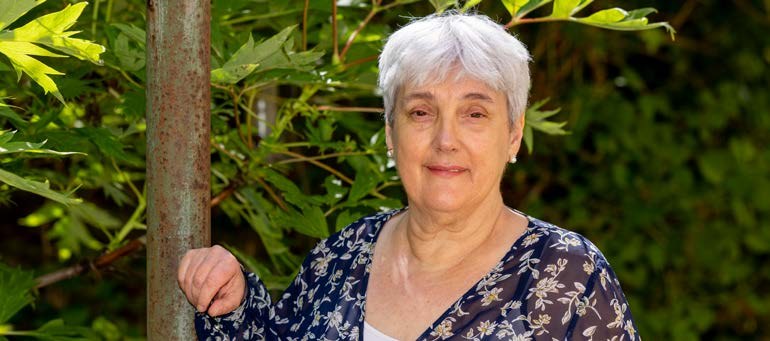
By Fiona Scott-Barrett
Fiona Scott-Barrett is a novelist and former English language teacher who has lived and worked all around the world. Her debut novel, The Exit Facility (2021), was runner-up for the Society of Authors’ ADCI Literary Prize in 2023. Like Fiona herself, the novel’s heroine lives with a rare inherited eye condition that causes the gradual loss of central vision. Here, Fiona writes with characteristic candour and wit about living with Best’s disease, the uneasy balance between coping and hoping, and the unexpected challenges posed by eye injections, Disability Pride Month and a particularly uncooperative pair of sandals.
Coping without hope
When I was diagnosed with Best’s disease 46 years ago, I was told unequivocally that there was no treatment and no cure.
It was explained to me thus: the disease follows different stages, one of which produces a fried-egg-shaped lesion on the macula, the central part of the retina. This egg-like deposit then breaks up, or “scrambles”, before eventually leaving atrophy or scarring.
As I understood it, the damage could not be removed by laser or any other means without risking further harm to my remaining sight. No sight at all, I reasoned, would be far worse than limited central vision.
This may seem rather brutal, but I have always found it comforting to know that nothing could be done to alter matters. Hope would be pointless and pathetic, rather like an amputee hoping that his lost arm might spontaneously regrow like a lizard’s tail. By firmly pushing hope back into Pandora’s box, I was freed to concentrate on coping with life with a visual impairment.
Coping was easy in the early years and involved few adjustments. As the degeneration has continued, however, it has become more challenging. I am slower to do everything, from getting ready in the morning and cooking a meal to entering an ID code into my phone. I can barely read other than on-screen, write illegibly and can’t really be trusted to shop on my own.
I am lucky to have people who help me and, when they are not available, I am not shy about requesting help from strangers. Of course, there are times when I become frustrated by my inability to function as well as I used to, but I try to treat them with humour, using myself as the butt of my own jokes.
When the rules change
Recently, however, several events have upset my equilibrium.
In my case, periods of degeneration have been separated by periods of stability lasting months or sometimes years. Doctors therefore like to monitor the condition regularly, even though nothing can currently be done to cure it.
Unfortunately, Edinburgh’s large eye hospital closed in autumn 2024 for urgent repairs and remained closed for several months, with services transferred elsewhere. Combined with the depredations the pandemic caused to health services, this meant that some patients fell through cracks in the system. I was one of them.
I had not seen my own consultant for two years when I finally received an appointment for a retinal scan. A while later, my consultant rang me out of the blue and asked me to attend an urgent appointment for an eye injection because abnormal blood vessels had grown in one eye and were leaking.
This alarmed me, as the possibility had not been mentioned in the script I was handed 46 years ago. Nevertheless, I have dutifully shown up for three eye injections and now await a scan to confirm whether they have been effective. Quite apart from the fact that I find having needles stuck into my eyeball distressing, the whole situation disconcerts me.
It has allowed Pandora’s last evil to push open the lid of the box and introduce a new notion: not that these interventions will cure my sight, but that they may halt or delay further damage caused by this complication.
This has utterly upset my “coping, not hoping” paradigm.
Why “pride”?
The second thing that's been bothering me concerns semantics.
Social media informs me that July is Disability Pride Month. I would understand Disability Action Month, Disability Recognition Month or Disability Awareness Month. I do not deny that it is important for the general public to understand the difficulties and prejudices disabled people face, or to consider how life could be made easier and more accessible.
But why “pride”?
I am in no way proud that a tiny error in my DNA has given rise to an incurable eye disease. Why should I be? On the other hand, neither am I ashamed of it. It is an accident of DNA coding whose effects I have to live with. I understand that, for many people, Disability Pride means rejecting shame and refusing to be diminished by disability.
Nevertheless, bringing pride into the equation feels as useless and fatuous to me as invoking hope. And now for my final whinge.
My final whinge
Recently, an old friend and I discovered that, as children, we had both been sent home by the school nurse with notes informing our parents that we had flat feet. In both cases, nothing was done, whether through indifference or because no information was supplied about what could be done or what the ramifications might be.
Nowadays, we both have flat feet and suffer pain and complications that we believe may be connected to them.
My friend’s condition is not as severe as mine. I have experienced episodes of terrible, whole-body pain while wearing corrective insoles. Other people tell me that mild discomfort for a couple of weeks is normal. I, on the other hand, regard insoles as instruments of torture.
Ironically, the only parts of my body that do not cry out in agony are my feet.
Nineteen months ago, I approached an orthopaedic shoemaker who said he could produce custom-made sandals that would support my fallen arches, improve my gait and posture, and eliminate the pain.
What I had not reckoned with was that he is based in London, while I live in Edinburgh, and that his promised “regular” visits for fittings would become increasingly infrequent.
I finally took possession of the sandals earlier this month. They seem to fit and support my fallen arches.
There is only one problem: because of my diminished eyesight, and because the holes in the straps are new, intangible and nearly invisible, I cannot actually do them up by myself. A week ago, I was rescued by a charming mother-and-son duo who found me sitting morosely on the steps of a dentist’s surgery, attempting to adjust the straps. The mother briskly instructed her son to help me, and he obligingly sat down on the pavement and buckled my shoes.
A little hope after all
But now, hoping has overtaken coping.
I am living in hope that the holes in the straps will open up enough for me to feel where they are and slip the pins of the buckles through them. If that happens, I can gradually train my body to accept the new posture created by the sandals’ orthopaedically shaped inner contours.
This will not be easy, but no doubt hope will stick her pesky head out of the box again, and I will start living for the day when the sandals do their work and the stupefying pain finally abates.
If that does not work, I shall screw the lid of her box shut forever and buy myself a mobility scooter.
At least you know where you stand, or perhaps sit, when you rely on coping to see you through.
With thanks to Fiona Scott-Barrett for sharing her story with honesty, humour and insight, and for her continued contributions to our newsletter. Her novel The Exit Facility, which features a partially-sighted heroine, is available to purchase on Amazon for £9.99 in paperback, and is also available as an audiobook.