By The Partially Sighted Society
Claude Monet spent his life pursuing things that could never be held still.
Sunlight trembling across water. Mist rising from the Thames. Shadows passing over a haystack. The stone façade of a cathedral transformed by the hour. He returned to the same subjects again and again because, to Monet, they were never truly the same. Light moved, colour shifted and the world remade itself from one moment to the next.
In his later years, however, it was not only the world before him that was changing. Monet’s own vision was becoming increasingly unreliable.
By then, he was already among France’s most celebrated artists. In 1883, he had moved to Giverny in Normandy, where he gradually created the garden that would dominate the final decades of his life and work. Its pond, water lilies, willow trees and Japanese-style bridge became far more than picturesque subjects. Together, they formed a private world that he could study endlessly, watching as weather, reflections and daylight altered its appearance.
From the late 1890s until his death in 1926, Monet devoted much of his attention to his Water Lilies. What began as recognisable views of a garden gradually became something more ambitious and immersive. Horizons disappeared. Reflections merged with plants and sky. In the largest canvases, the viewer no longer seems to be standing beside the pond, but surrounded by it.
Yet as Monet’s artistic ambitions expanded, his ability to see the garden clearly was deteriorating.
A world losing its clarity
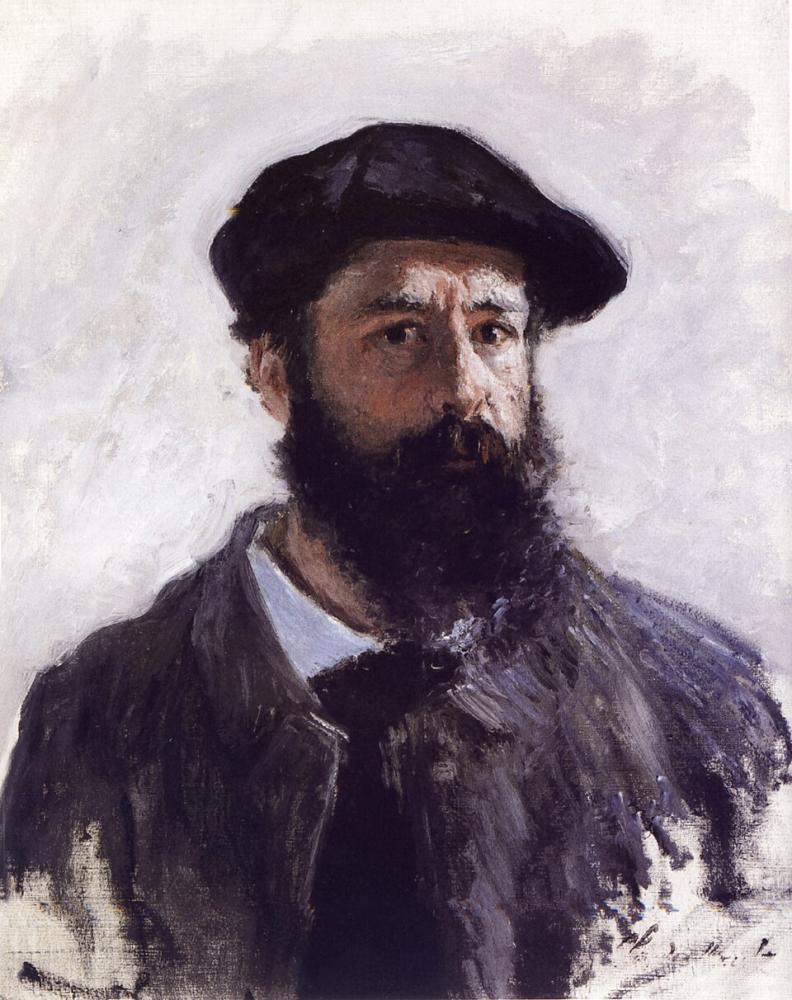
Claude Monet, self-portrait.
Monet had become aware of difficulties with his sight by 1912, when doctors diagnosed cataracts in both of his eyes.
His vision did not disappear suddenly. Cataracts usually develop gradually, causing the world to become increasingly blurred, dim or hazy. They can also alter the way colours are perceived. In Monet’s case, the lenses of his eyes were becoming darker and more yellow, filtering the light that reached the retina. Cooler colours, particularly blues and violets, became more difficult to distinguish, while subtle variations in shade were increasingly lost.
At first, Monet continued to work using a combination of his remaining vision, his memory and the experience of a lifetime spent studying colour. As the cataracts progressed, however, even recognising the paints on his palette became difficult. He reportedly began relying partly on the labels attached to his paint tubes rather than trusting his eyes alone.
The cruelty of this is difficult to overlook. Monet had built his career upon seeing what others missed. He noticed the smallest movement of light and the quietest change in atmosphere.
Now colours appeared duller or muddier, and paintings could grow darker without him fully realising it. By 1922, the vision in his better eye had reportedly fallen to around 20/200. He restricted his work to certain times of day, when the available light gave him the best chance of seeing, and began to fear that he might have to abandon painting altogether.
The effects are particularly striking when two of Monet’s paintings of the Japanese bridge are placed side by side. In Bridge over a Pond of Water Lilies, painted in 1899, the pale arch of the bridge remains clearly defined. Water lilies float across the pond, reflections ripple beneath them, and greens, blues and touches of pink create a scene that, despite Monet’s loose Impressionist brushwork, remains immediately recognisable. The bridge provides a clear structure across the canvas, while the flowers, foliage and water retain their separate forms.
Compare this with The Japanese Footbridge, painted around 1920 to 1922, when Monet’s cataracts had become severe. Here, the bridge is almost swallowed by the garden. Dense strokes of maroon, orange, rust and gold crowd the canvas, while plants, water and reflections merge into one turbulent surface. Forms have become broader, edges less certain and the familiar garden appears to be dissolving into colour and movement.
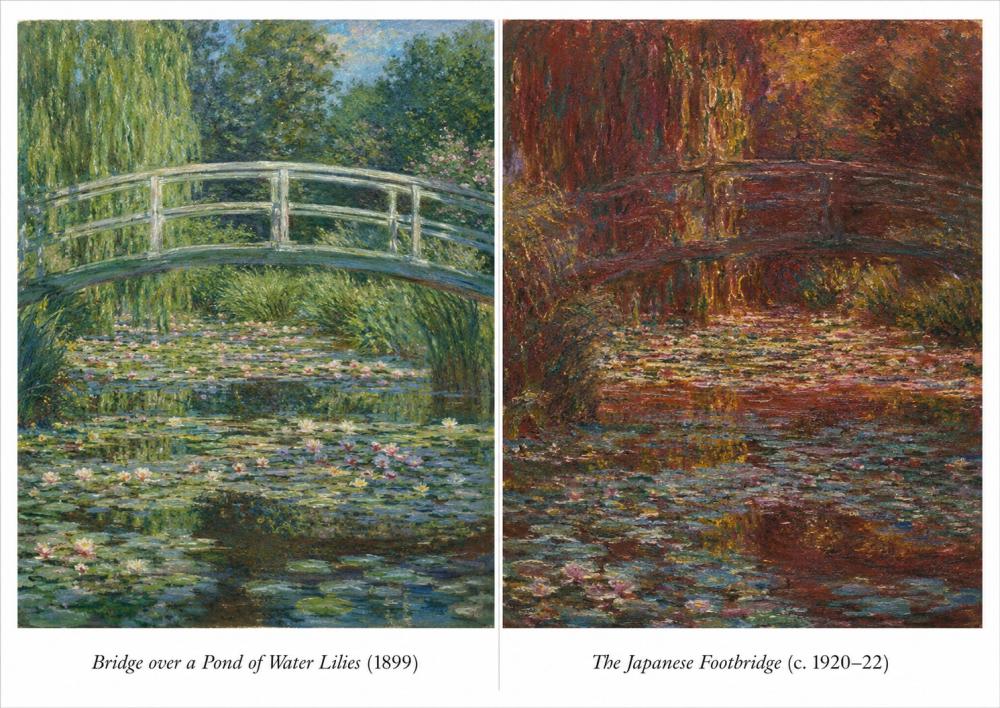
Bridge over a Pond of Water Lilies (1899) and The Japanese Footbridge (about 1920–22).
The difference is so pronounced that the two paintings can seem to belong to entirely different artistic worlds.
Medical researchers have argued that Monet’s cataracts contributed significantly to this transformation. The yellowing of the lenses would have reduced his ability to distinguish cooler colours, while blurred vision made fine detail and precise edges harder to judge. A painting could therefore have appeared very different to Monet than it did to somebody with clearer sight.
It would be a mistake, however, to explain every change in his work as a medical symptom.
Monet was not a passive recorder, simply copying whatever his damaged eyes presented to him. He remained an experienced, imaginative and highly deliberate artist. He was also working during a period in which European art was moving steadily towards abstraction. His knowledge of colour, composition, rhythm and paint remained intact, even when his vision no longer behaved as he expected.
His cataracts altered the conditions under which he painted, but they did not paint the pictures for him.
That distinction matters. Sight loss may change how a person works, but it does not erase their judgement, imagination or identity.
The fear of surgery
Doctors advised Monet to have an operation, but he resisted for years. Cataract surgery was already an established treatment in the early twentieth century, although it was far less routine and predictable than it is today. Monet was particularly afraid that surgery would alter his perception of colour and leave him unable to trust what he saw.
For an artist whose entire life revolved around colour, this fear was entirely understandable.
He eventually underwent surgery on one eye in 1923. His ability to read improved, but the adjustment was neither immediate nor easy. For more than a year, he complained that colours appeared unnaturally yellow or blue. His operated and untreated eyes were effectively presenting him with two different versions of the world.
He also became deeply unhappy with some of the paintings he had produced while his cataracts were at their most severe. He destroyed a number of canvases, while others survived only because relatives and friends intervened. In some cases, he returned to earlier works and altered them after surgery.
This complicates the appealing idea that Monet simply accepted his changing vision and confidently discovered a daring new style. The reality was far more human. He adapted, struggled, doubted his own work and sometimes rejected what he had made.
Neither tragedy nor artistic gift
There is a danger in romanticising the relationship between disability and creativity. Monet’s cataracts influenced the appearance of his later work, but they were neither the source of his greatness nor a necessary part of his artistic development. The distress and practical difficulties they caused should not be treated as a fortunate artistic gift. His sight loss brought frustration, uncertainty and fear. It threatened his independence and his confidence in the very skill upon which his life had been built.
His achievement lies not in having cataracts, but in continuing to work despite them.
When the methods he had relied upon for decades became less dependable, he searched for alternatives. He painted familiar surroundings. He used labelled materials, memory, carefully selected lighting and an extraordinary depth of experience. After surgery, as he gradually regained confidence in his vision, he returned to the monumental Water Lilies and continued to refine them.
The vast panels now displayed in two oval rooms at the Musée de l’Orangerie in Paris were designed to surround the viewer with an apparently endless expanse of water, light and reflection. Monet offered works from the series to the French state as a symbol of peace after the First World War. They were installed in 1927, several months after his death.
Today, these paintings are often seen as a bridge between Impressionism and the abstract art that followed. Their importance does not lie simply in the fact that Monet was losing his sight. It lies in the way he continued to interpret the visible world even as his relationship with it was changing.
The artist remained
Monet’s later life challenges one of the most persistent assumptions about sight loss: that losing vision means losing the ability to create, contribute or continue being oneself. The reality is rarely so simple.
Sight loss may require new tools, unfamiliar routines or a complete reconsideration of how everyday tasks are approached. It can bring anger, grief and uncertainty. It may also change the outcome of a person’s work in ways that neither they nor those around them initially expect.
But adaptation is not the same as disappearance. Monet could no longer depend upon colour in the way he once had. What remained, however, was a lifetime of memory, technique and curiosity, together with the determination to continue placing paint on canvas.
His later paintings do not offer a neat story of triumph over adversity. They offer something more honest. Creativity did not make his sight loss disappear, and sight loss did not erase the artist he had spent a lifetime becoming.
The garden changed before his eyes. Monet changed with it. And he continued to paint.