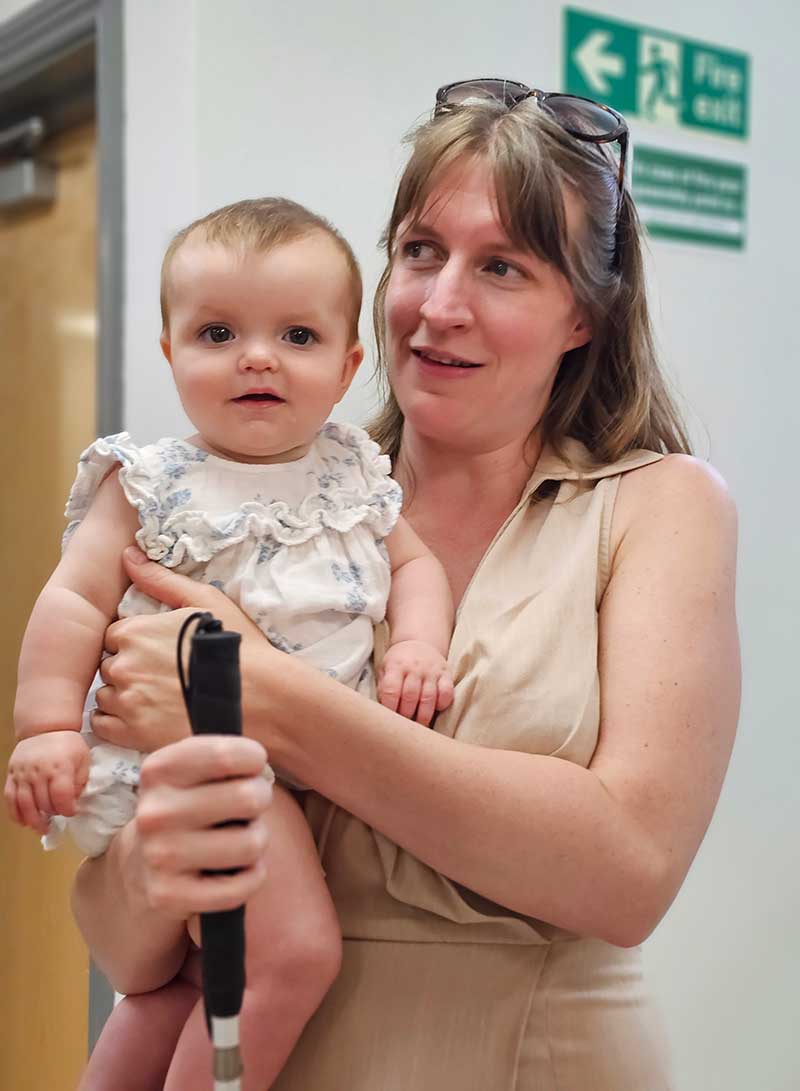
The first cry, the tiny grasp of a hand, the warmth of a head tucked into a shoulder — these moments define the beginning of life. But what does it mean to experience them without sight? For Robyn, Vice Chair of the Partially Sighted Society, and Keith, Chair of the Board, it means learning to feel, listen, and adapt, and discovering joys that are not only visual but profoundly sensory.
Robyn, who lost her sight at a very young age, welcomed her baby nearly a year ago. The last months have been a period of intense learning and adaptation. “It’s been a whirlwind of new experiences,” she says. “I’ve stepped back a little over the past year because I had a baby, but it’s been incredible.”
Her blindness has posed challenges, but Robyn has approached motherhood with creativity and meticulous organisation. “Things are difficult until they aren’t anymore — once you’ve done them enough times, they become second nature,” she explains.
Changing nappies, a task many new parents find daunting, became a lesson in tactile ingenuity. “I always set everything up before starting — fresh nappy, wipes, and bin open — so I can stay organised. I even lay a wipe under the baby’s bottom before cleaning, in case feet go where they shouldn’t!” she says. To keep her child entertained, Robyn calls the pack of wipes the “baby wipe stick.” And when things go awry, there’s no hesitation: “If it’s a really bad one, sometimes it’s just easier to put her straight in the bath! I’d rather over-clean than under-clean.”
Feeding and medication are also exercises in ingenuity. Robyn relies on sound and touch to guide her: “I listen for her breathing, her swallowing, or any changes in her tone. For drops, I do it into an empty bottle first so I can feel the drop land before adding it to milk. We also use a ‘medicine dummy’ that releases medicine as she sucks.”
Sleep, too, has had its trials. “She’s been breastfeeding since birth, and after the four-month sleep regression, nights became unpredictable. But recently she’s been settling better and sleeping in her cot more often,” she says.
Through it all, joy resonates in ways that sight cannot capture. “Her laughter — it’s the best sound in the world. At first, I felt sad not seeing her facial expressions clearly, but her voice and giggles make up for it completely,” Robyn reflects.
Organisation and routine are her allies. “I keep baby clothes in size order, use dividers in drawers, and keep outfits together with little clips. Everything
gets washed in mesh bags so nothing gets lost. Preparation, routines, and a predictable environment help you relax and enjoy the moments more,” she advises.
For Keith, grandparenthood arrived in rapid succession: “I became a grandparent just under a year ago, and then again about eight weeks ago. So, it’s been a busy time he says.
Keith lives with severe visual impairment caused by NAAION (Non-Arteritic Anterior Ischemic Optic Neuropathy), a condition resulting from damage to the optic nerve. Yet he remains active, noting with a laugh, “I still cycle and ski — it’s my knees that slow me down more than my sight!”
For Keith, the sensory side of grandparenting — the touch, the sound, the rhythm of care — brings profound satisfaction. “For me, it’s the cuddles. There’s nothing like holding a baby — it’s calming and grounding. I also love hearing them laugh,” he says.
He listens intently for the cues sighted grandparents might take for granted. “My wife often spots things I can’t, like flushed cheeks if a baby’s too warm. But I’ve learned to rely on sound. You notice breathing, swallowing, even tiny noises that indicate discomfort. It becomes second nature.”
Practical planning ensures safety and reduces stress. “Clearing safe spaces and anticipating their next stage helps a lot. Mats on the floor, organised toys, and clear routines allow you to enjoy time with the little ones without anxiety,” he explains.
Both Robyn and Keith are determined to challenge assumptions about visually impaired caregivers. “People can be nervous about blind people holding babies, but we’re more capable than they think,” Keith insists. “Babies respond to care, not eyesight. Don’t be afraid. Be confident and hands-on.”
Robyn echoes the sentiment: “Build a support network. If you can, connect with others in the same situation. Even just reading other people’s tips helps.” She also calls for more inclusive design in baby equipment: “To use a pram safely with a white cane or guide dog, you need a handle that flips over so you can pull it rather than push. Only two prams have that option, and one’s been discontinued. We need more inclusive designs.”
Ultimately, for Robyn and Keith, the richness of parenting and grandparenting lies in presence and connection. The feel of tiny fingers curling around a hand, the sound of a baby’s laugh, the gentle rhythm of breathing — these are the details that matter most.
“Grandparenting is about love, patience, and being present,” Keith says. “Vision helps, but it’s not everything. Adaptation and care are what matter most.”
Robyn adds, “Her laughter, her voice — it’s what makes all the challenges worthwhile. Sight doesn’t limit the connection; it just changes how you experience it.”
For Robyn and Keith, parenthood and grandparenthood are reminders that the essence of these roles lies in engagement, attention, and love — senses that reach far beyond just vision alone. Listen to the full interview with Robyn and Keith on our YouTube.